As far as American farmers are concerned, “King Corn” will retain its crown for another year.
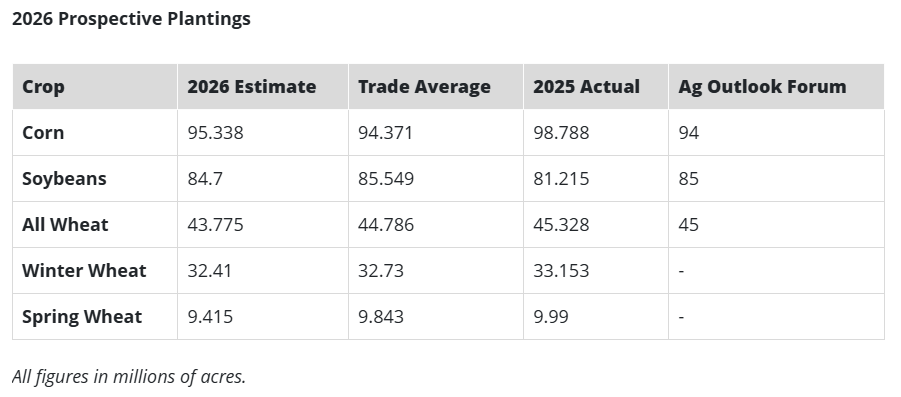
That’s one takeaway from today’s USDA Prospective Plantings report, which included an unexpectedly high corn acreage forecast at 95.338 million acres. That figure marks a 3.4% drop from last year’s plantings, which were a nine-decade high, but was about 850,000 acres above the average analyst estimate.
The same report showed estimated soybean plantings at a lighter than expected 84.7 million acres, up 4.3% from 2025’s six-year low but about 967,000 acres short of the average estimate.
USDA’s acreage estimates suggest many farmers see greater profit potential in corn compared to soybeans and other crops even after last year’s record 17.02 billion-bushel harvest swelled supplies to multi-year highs. This year’s expected planted acreage would be the fourth highest since the end of World War II and could generate a near-record harvest if weather cooperates.
“According to the USDA, corn is still king,” Jeremy McCann, farmer relations manager at Farmer’s Keeper Financial, said in a report. “This comes as a surprise to much of the trade, as we face barely breakeven prices and incredibly high input costs. This number represents farmer sentiment of being able to yield themselves out of bad prices.”
USDA’s acreage estimates were based on mail, phone and internet surveys of about 73,800 farm operators during the first two weeks of March, the agency said.
Despite the bearish acreage figure, corn futures held up relatively well today, with the new-crop December contract edging up 0.25 cent to $4.8425 per bushel following a volatile, two-sided session that saw prices briefly dip to a two-week low.
The bullish soybean acreage number sent November futures up 13.5 cents to $11.5750, the contract’s highest settlement since March 13. July SRW wheat jumped 9.25 cents to a three-week high at $6.1625 following a lower-than-expected USDA acreage forecast.
High corn acres may keep supplies burdensome
Corn plantings are seen historically high even with the Iran war disrupting global energy and fertilizer markets, making already costly fuel and crop nutrients even pricier. Another year of high plantings, combined with favorable growing conditions and strong yields, could generate another huge crop that adds to already-burdensome supplies and weighs on prices well into 2027.
While USDA’s acreage numbers diverged widely from many analyst forecasts, the numbers still reflected an expected expansion in soybeans, some downsizing in corn and continued moves away from unprofitable crops like rice and wheat.
USDA forecast corn acreage declines in seven of nine prime growing states, with Iowa plantings shrinking 450,000 acres to 13.1 million acres and the Dakotas dropping a combined 850,000 acres, or 7.4%. By contrast, corn plantings in Kansas were seen up 250,000 acres to 7.1 million acres.
Combined corn and soybean acres in 2026 are seen at slightly over 181 million acres, up 0.6% from 2025 and representing over 58% of all U.S. crop area.
Farmers planting more soybeans this year may be motivated in part by demand optimism, including sharply higher biofuels blending mandates announced by the Trump administration last week. Smaller than expected acreage could signal tighter supplies during a time domestic processors are crushing soybeans at a record pace in anticipation of higher biofuels use.
Iran war impact: Has farmer “changed his outlook?”
Analysts cautioned that USDA’s acreage numbers are preliminary and, because results were gathered during the first half of the month, may not fully reflect the impact of the Middle East war that sent fertilizer prices soaring. Spring weather could also alter acreage decisions. USDA will update its acreage numbers at the end of June.
“The story is definitely in the corn,” Jim McCormick, chief operating officer at AgMarket.Net, said in a video posted on LinkedIn. He noted that the grain market was bracing for lower corn plantings after the spike in fertilizer over the past month.
“That will be the debate within the industry: Has the farmer changed his outlook or his planting intentions after he submitted his (survey), simply because the price of fertilizer continues to move higher as well as the cost of energy in general,” McCormick said. “Remember, this is just the beginning point of the story. We still need to see what gets planted.”
Corn also has a bullish demand story, including a record export pace and strong ethanol exports. But any rallies could be muted by another big harvest, analysts warned. Based on today’s USDA acreage figure and a “trendline” yield around 183 bushels per acre, this year’s crop could approach 16 billion bushels.
A harvest of that size could, in turn, lead to the second year in a row in which U.S. corn ending stocks surpass 2 billion bushels. USDA pegged 2025-26 ending stocks at 2.127 billion bushels, a seven-year high.
Considering the heavy supply outlook, farmers would be wise to seek near-term opportunities for pricing new-crop corn at favorable levels, McCann said. “Continue to lock in profitable corn prices as you're able to because with a favorable growing season, end stocks are likely to be above 2 billion bushels once again,” he said.
While soybean prices remain up sharply from January lows and retain bullish demand underpinnings, the market is not without downside risk. U.S. exports are down sharply this year in the wake of last year’s trade dispute with China, the world's top soybean importer.
An expected May meeting between President Trump and Xi Jinping has fostered hopes for additional China purchases of U.S. beans. But it’s an open question whether China will ultimately meet the longer-term pledged purchases touted by the White House.
“A lot hangs in the balance” as the U.S.-China meeting looms, McCann said. “In short, continue to reward the soybean market with new crop sales.”
Wheat ground continues shrinking, stocks ample
USDA also forecast plantings of all varieties of wheat in 2026 at 43.775 million acres, down 3.4% from 2025 and the lowest in USDA records going back to 1919. Wheat seedings fell far short of expectations for a number closer to 44.786 million acres.
Plantings of spring wheat varieties other than durum shrank nearly 6% to 9.42 million acres, the lowest since 1970.
Also Tuesday, USDA said U.S. corn stockpiles as of March 1 totaled 9.024 billion bushels, up 11% from a year earlier, according to the agency’s quarterly Grain Stocks report. Corn stocks were slightly below trade expectations. March 1 soybean stocks totaled 2.105 billion bushels, up 10% from a year earlier and slightly above expectations.
Wheat stocks as of March 1 totaled 1.3 billion bushels, slightly below expectations but up 5.1% from a year earlier.
The following table summarizes USDA’s Prospective Plantings and Grain Stocks reports (trade averages based on a Reuters survey):