With the Iowa Master Farmer’s 100th anniversary falling on the United States’ 250th anniversary this year, Grant Menke, deputy secretary of the Iowa Department of Agriculture and Land Stewardship, highlighted an important patriotic connection.
“From the earliest days, farmers were among the first defenders of the country,” Menke said. “They were the minutemen and citizen soldiers who answered the call to defend freedom and pursue independence.”
Agriculture, which helped build the nation on the battlefield and in the crop fields, continues to be at the center of America’s story, Menke said at an awards event in Ankeny celebrating four new Iowa Master Farmer families and two Exceptional Service to Agriculture Award winners.
“In farming, you quickly realize that you are part of something bigger than yourself,” Menke said in his opening remarks. “It is never just about one season or one year. It is about stewardship across generations.”

The 2026 Iowa Master Farmers are:
The Exceptional Service to Agriculture Award winners are Kirk Leeds, Iowa Soybean Association CEO, and Greg Tylka, a nematologist with Iowa State University Extension and Outreach.
Storied history
Since 1926, Wallaces Farmer’s Master Farmer program has been intertwined with the nation’s agricultural history, spanning generations of farmers who’ve tilled black Iowan ground across agriculture’s dramatic evolution.
Some things haven’t changed — corn looks the same — while others have. The average yield between 1870 and 1930 hovered at 20 to 30 bushels per acre across the U.S. In Iowa, where 213,000 Iowan farms averaged 157 acres, it was about 10 bushels higher.
“What’s the biggest message? There wasn’t any yield improvement,” said David Bowen, laureate and senior analyst at Corteva Agriscience. “Over six decades, not much changed.”
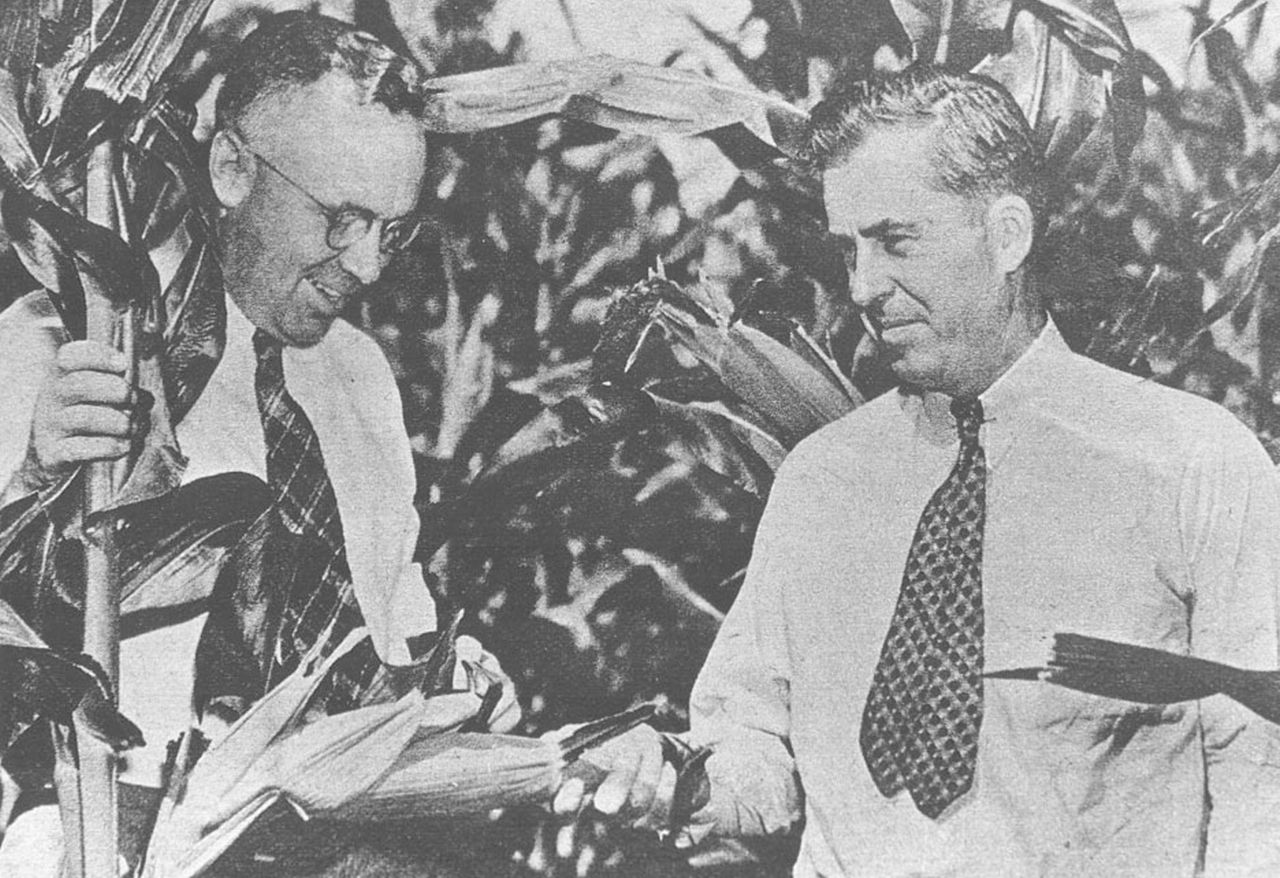
And then, “uncle Henry” Wallace, who served on many U.S. ag committees, came onto the scene, founding Wallaces Farmer with the guiding principles “Good Farming, Clear Thinking and Right Living.” His son, Henry C. Wallace, carried the publication forward as its editor while also working as a professor at Iowa State College and the 1921 USDA secretary; as did his grandson, former U.S. Vice President Henry A. Wallace, who founded the Hi-Bred Corn Co. and became the secretary of commerce and USDA secretary.
“He was a hair’s breadth away from being the president,” Bowen said. “He entered hybrids early in the 1920s, both by himself and with collaborators, to see how hybrids stacked up against the open-pollinated class.”
At home, the Wallace grandson bred corn in his garage, shared germplasm, exchanged ideas and began testing his garage-developed hybrid corn’s performance in the field. He co-organized the Iowa corn yield test and a scientifically consistent testing process across defined regions.
Several years later, the open-pollinated class gave way to superior hybrids. Bushel production increased in leaps and bounds — up through 30 and 40 bpa in those early years, all the way up to the current National Corn Growers Association yield record of 623, held by Virginia farmer David Hula.
Honoring farmers
Concurrent to promoting hybrid advancement, the Wallaces asked, “Who are the Master Farmers?”
“We want to know who they are. The applications went in. Reporters from Wallaces Farmer went out and did interviews, [and] then in January, they announced 14 Master Farmers. Their average age was mid- to late 40s. The average farm size was 250 acres. All were officers in leading farm organizations.
“This is what’s super exciting and interesting about the Master Farmers organization. It’s not just about farming; it’s about civic activity, the promotion of agriculture,” Bowen said. “The awards specifically acknowledged the familial labor that still sustains American farms by spouses as ‘equals.’”
This stance for equality was pervasive throughout the history of Wallaces Farmer. Its founding principles of “Good Farming, Clear Thinking and Right Living” ethically guided the publication through the morally turbulent civil rights era, during which the paper’s journalists took a strong editorial stance promoting equal rights. In regular columns, writers consistently advocated for marginalized farmers, including Black sharecroppers and foreign laborers.
And in his editorial leadership and participation in the Roosevelt administration, Henry A. Wallace infused a criterion of morality into the Master Farmer program’s selection criteria.
“He wanted the people who actually lived these values in person,” Carlisle farm owner Rob Fleming said about his great-uncle, Henry A. Wallace. “It wasn’t just an abstract thing at the top of the paper. I’m very moved by the fact that he brought them to life in a valuable way, and it obviously worked, as it has been ongoing for 100 years now.
“It is obvious that every one of you meets the very rigorous, demanding criteria,” Fleming added, noting his great-uncle’s last words were, "It is time to begin.”
Future challenges
Like the Wallaces, who overcame their day’s challenges through civic engagement, scientific research and journalism, today’s farmers similarly stand at the precipice of unprecedented evolution being trigged by disparate stressors that have suddenly converged: environmental concerns, rural-to-urban migration, high costs, labor shortages, political quagmire and volatile markets.
Modern row crop farmers break even or lose money two-thirds of the time, said Paul Schickler, retired president of DuPont Pioneer, who highlighted consumer interest in food production methods and climate change concerns are driving demand for changes in agriculture. Financial margins are slimming, even while productivity is increasing tenfold.
"The problem has been, and continues to be, that the burden of these issues — more nutrition, better products and a better environment — their risk and cost are all in the back of the farm,” he said. “But I think there are ways to overcome that, and I believe that things are changing to enable them to occur.”
How? Innovators like those recognized at this year’s Iowa Master Farmers event are improving commodity crop oil and protein content, and fortifying nutrients to increase their value. Biofuels are emerging as a solution to both climate change and farm income. Advanced technologies like precision agriculture and artificial intelligence are driving gene-editing capabilities and robotics.
Integrating all of these advancements is poised to change markets, Schickler said, and establish mechanisms for farmers to disembark from the volatile commodity market. The key, he said, is to capitalize on increasing consumer interest in food production.
“I think the opportunity in the future is tremendous to increase the value through those capabilities, so farmers get paid more than just to come out of the value of what you are producing,” Schickler said.
By capitalizing on these emerging opportunities, American farmers can carry the nation’s storied agriculture onward for another 250 years and beyond, Schickler said.
Nominations for next year’s Master Farmer Awards are open. If you’d like to nominate a 2027 Master Farmer, applications are available and due Sept. 18.