With seeds barely in the ground, Iowa farmer Jonathan Kinzenbaw’s 2026 planting season has already diverged from its recent trajectory. After years of drought, continuous rainfall this year pushed his planting later than in the past, but he’s off to a decent start.
“Usually, I’m used to planting in the 80 degrees and in the dusty conditions,” Kinzenbaw said. “This year, there’s days I planted with a jacket on. It was chilly when I was filling the planter, but the soil conditions were right, and the forecast looked good.
“Thanks to high-speed planting technology, we’ve been able to get most of our row crop planted in that time. I’m down to about 2 days left of planting, and I’ll be done.”
Storms narrowed this year’s planting window in Warren County. Given that atypical weather to start, “I think this year has favored the prepared,” he said. “We are glad that we waited to put our nitrogen down until just before planting, because with all the rain, some farmers might find that the nitrogen they put down early got pushed deep into the soil.”
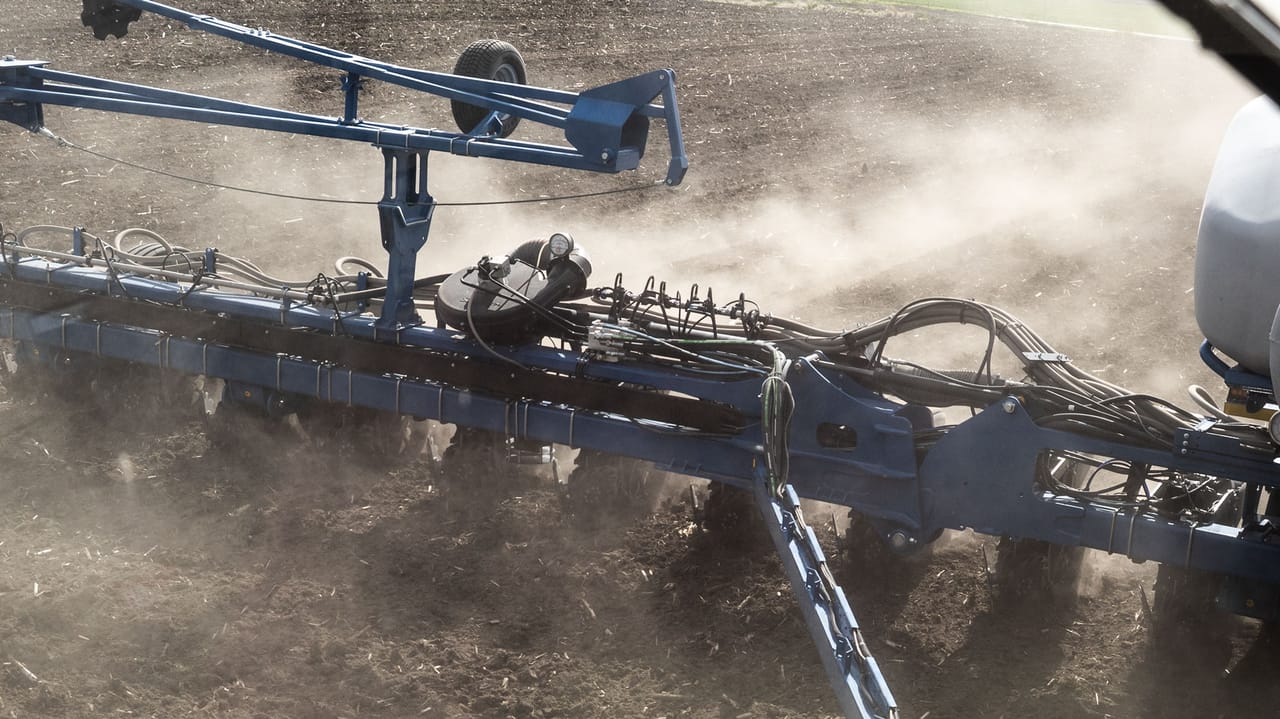
Kinzenbaw, who farms about 2,000 acres of mostly corn and soybean in Indianola, waited until April 29 to start planting — roughly two weeks longer than neighboring farms.
The soil moisture has been good. “We have dryness in the top 6 to 8 inches that we really need to effectively plant without creating compaction. So I’m very pleased that we waited,” he said.
Once planting wraps up, Kinzenbaw plans to cut alfalfa hay for a regional beef buyer he’s supplied for the past three years — a steady market that’s helped anchor his income through a volatile commodity season. For further financial stability, he plans to do more off-farm with his machines, including bulldozers and excavators.
As the season gets going, he’s keeping an eye on several concerns, including the weather: “If it turns out like a year like 2012 was where it stops raining and doesn’t rain anymore then we’ll be in trouble,” he commented. Within the market, commodity prices are erratic. Oil prices are unpredictable. There’s a lot of uncertainty ahead. And next year’s fertilizer seems like it’s going to be more expensive than ever.
“The price of corn is a continuous variable, much like the oil market that fluctuates up and down based on global conditions,” he said. “The bottom line is, are we going to have the profit margin we need to be profitable this year?”
[[scm-embed type="infogram" id="f236e5ed-3bff-4244-8a01-7eab8876de48" data-title="Field Checks Map"]]