by Dirk E. Maier
Damage caused by persistent September rains across most of the western Corn Belt showed up as quality challenges in corn and soybeans at harvesttime. Despite the rapid change in the weather from rain and high humidity to sun and lower humidity, the damage was done.
A range of field molds on ears of corn and soybean pods has resulted in more kernel discoloration than usual and higher-than-normal mycotoxin levels.
The latter is of greatest concern because mycotoxins cannot be undone by even the best drying, handling and storage practices on farms or at elevators. Nor can they be undone through processing in a feed mill, dry or wet corn mill, ethanol plant, or soybean crushing plant.
Mycotoxins can only be mitigated by blending to dilute high concentrations and by adding mycotoxin binders to feed rations. Preliminary research at Iowa State University during the 2025 harvest season showed that screen-cleaning can reduce mycotoxin levels in screened corn by 2.5 to 7.5 times.
The ISU Kent Feed Mill and Grain Science Complex has been receiving corn and soybean samples that, upon testing, showed high levels of zearalenone and deoxynivalenol (DON), which is sometimes called vomitoxin. These are two mycotoxins of concern for feeding swine, poultry layers and other animal species.
Both mycotoxins result from Fusarium graminearum (also known as Gibberella zeae), which is the fungus that causes Gibberella ear rot. Gibberella ear rot tends to increase when cool, wet weather occurs during early silking in corn.
Extended periods of rain — as experienced during September — that delay harvest can increase Gibberella ear rot severity and mycotoxin concentrations, which impacts the quality of corn and soybeans.
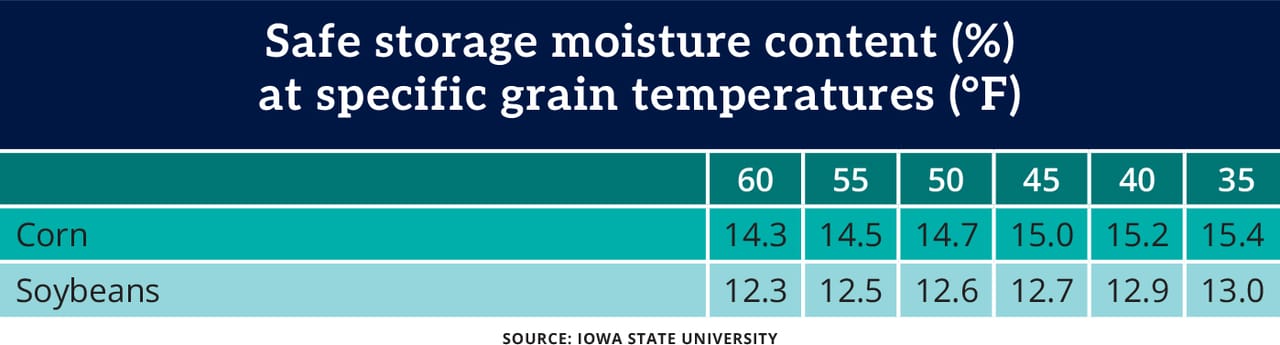
Unfortunately, the concentration of DON or zearalenone can be high even when the disease does not appear to be severe in the field. It can further increase during storage if corn is not dried and cooled quickly after harvest to safe storage moisture content (see table).
For mold-damaged corn and soybeans, the best practice is to lower the listed safe storage moisture content values by at least 0.5 percentage points.
Impact on livestock
DON affects an animal’s gastrointestinal tract. It often causes vomiting, feed refusal and reduced weight gain in swine, poultry layers and other animals. DON also suppresses the immune system and can inflame the central nervous system.
Zearalenone has estrogenic properties and can cause estrogen overload, a condition that is particularly harmful to female breeding animals. It can cause infertility, abortion, and other breeding and reproduction problems.
Swine are the most sensitive livestock to zearalenone, while beef cattle are less so. In poultry layers, egg production is affected.
Practical guideline limits in finished feeds to reduce negative effects on health and performance range from:
- 250 to 750 parts per billion in poultry layer/broiler/starter diets
- 25 to 75 ppb in sow/gilt/boar
- 50 to 150 ppb in nursery pigs
- 75 to 200 ppb in grower/finisher pig diets
- 200 to 1,000 ppb in beef cattle diets
It is important to note that even when individual mycotoxin levels appear moderate, the presence of multiple mycotoxins can produce compounding effects. These interactions may reduce feed intake, weaken immunity and lower overall animal performance.
Therefore, grain elevators, feed mills, dry and wet corn mills, ethanol plants, and soybean crushing plants across the region will (or should) be on the lookout during this marketing year. They should check incoming truckloads and rail cars for these two mycotoxins in particular.
What to do
Farmers should immediately consider delivering corn from fields with high levels of Gibberella ear rot and soybeans with high damage levels to grain elevators, taking the discount. This will help them avoid having to deal with potentially much higher discounts or load rejections later in the marketing year.
Grain elevators are better equipped to blend corn and soybeans to meet buyer specifications and mitigate the impact of quality challenges as they supply processors.
Ideally, fields with evidence of high mold damage should be harvested as quickly as possible and dried rapidly without extended wet holding. High-temperature drying can result in sterilized kernel surfaces, helping to reduce the chance of mold continuing to grow in storage. However, it will not reduce mycotoxin levels already present in the grain.
In comparison, slow-drying corn in bins with low temperature or natural air can cause continued mold growth and mycotoxin increase before corn reaches safe storage moisture content. Farmers with such systems would likely be better off delivering damaged corn to the elevator and taking the discount for moisture and total damage, rather than assume the storage risk.
The same holds true for soybeans. If wetter than 13%, soybeans could be dried on the farm, but it may not be worth the hassle.
In terms of storing this fall’s corn crop into next spring and summer, farmers and elevator managers will need to pay close attention throughout the storage season for signs of corn going out of condition. Ideally, bins should be equipped with functioning temperature cables that allow for monitoring of aeration cooling fronts, and with carbon dioxide sensors that monitor the onset of spoilage.
Cool corn to 35-40 degrees F and soybeans to 45-50 degrees F as soon after harvest as feasible. Additionally, the stored grain mass in each bin should be cored and unpeaked as soon after filling as possible.
ISU research has shown that partially unloading about 10% to 15% of the grain mass by weight will remove about 30% to 40% of broken corn and fines by weight concentrated in the core forming under the spout during bin filling.
This improves airflow uniformity and, thus, cooling of the grain mass. Most importantly, it removes the portion of the grain mass most susceptible to molding and self-heating.
Yes, such loads will be high in broken corn and fines likely exceeding the typical maximum Broken Corn and Foreign Material levels of 2% in Grade 1, 3% in Grade 2 or 4% in Grade 3 corn. However, taking the discount on a few such loads will pay for itself.
It also could potentially save a farmer next spring from getting engulfed while trying to unplug a bin that stopped unloading because chunks of spoiled and crusted corn blocked the center well.
Maier is an ISU professor and director of the Kent Feed Mill and Grain Science Complex.