Total costs of production of soybeans for a typical farm in Brazil are lower than total costs to produce a bushel of soybeans on a Midwest farm. Joana Colussi, assistant professor in ag economics at Purdue University, said that helps explain why Brazilian soybean growers have a comparative advantage.
However, one fact doesn’t tell the whole story. If a Brazilian farmer were telling it, he would point out that his direct production costs are much higher than for his American counterpart. And if he borrows money, John Ottte, retired Farm Progress economics editor, said his interest rate for borrowing money would likely be considerably higher.
To put U.S. vs. Brazil costs of soybean production into perspective, Colussi and Michael Langemeier, director of the Purdue Center for Commercial Agriculture, utilized data from the nonprofit Agri Benchmark to compare production cost changes from 2020 through 2024 for an average farm in Moto Grosso, Brazil, to a typical farm in Iowa.
Striking differences
Here are key findings from the Iowa vs. Mato Grosso comparison:
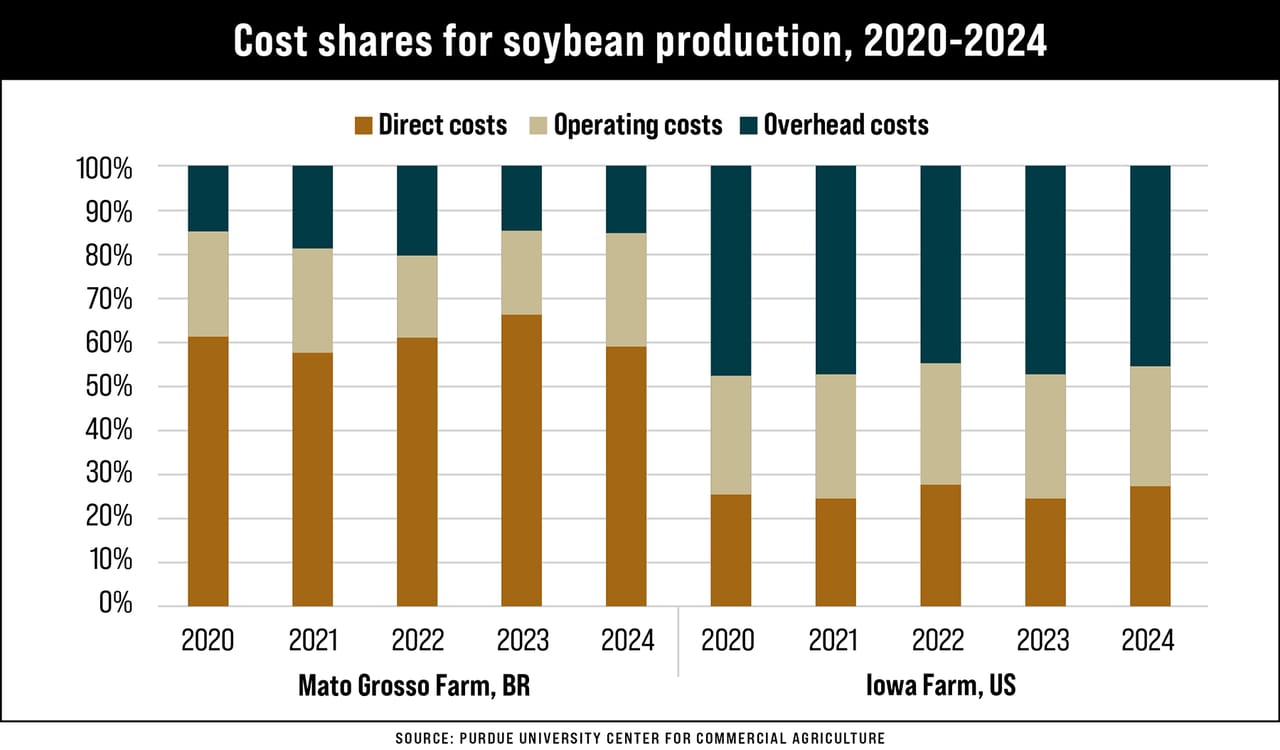
Mato Grosso farm costs. Direct input costs totaled 60% of the total soybean production budget, Colussi said. “It is a tropical climate, and input costs for insect and disease control are much higher,” she noted. “Plus, more fertilizer is typically needed.”
Some 70 million acres of pastureland in prime growing areas of Brazil could be targeted for conversion to soybeans over the next decade. However, many of those acres are low in nutrients and would require large amounts of fertilizer to restore productivity, Colussi said.
Iowa farm costs. Overhead costs, primarily related to higher land prices and cash rent, accounted for nearly half of total costs for the Iowa farm. In Brazil, overhead costs are about 25% of the total budget.
Mato Grosso cost trends. Starting in 2022, total cost of production for Brazilian farmers increased sharply and have nearly doubled since 2020, Colussi said. Increases are largely due to rising fertilizer costs. About 85% of all fertilizer in Brazil is imported.
Iowa cost trends. U.S. farmers complain about rising input costs, and they have gone up, but by a lower percentage compared to increasing input costs for Brazilian farms. Total costs to produce soybeans on the Iowa farm were about 13% higher in 2024 than in 2020. It still costs more to produce Iowa soybeans today compared to Brazil, but the gap has narrowed since 2020.
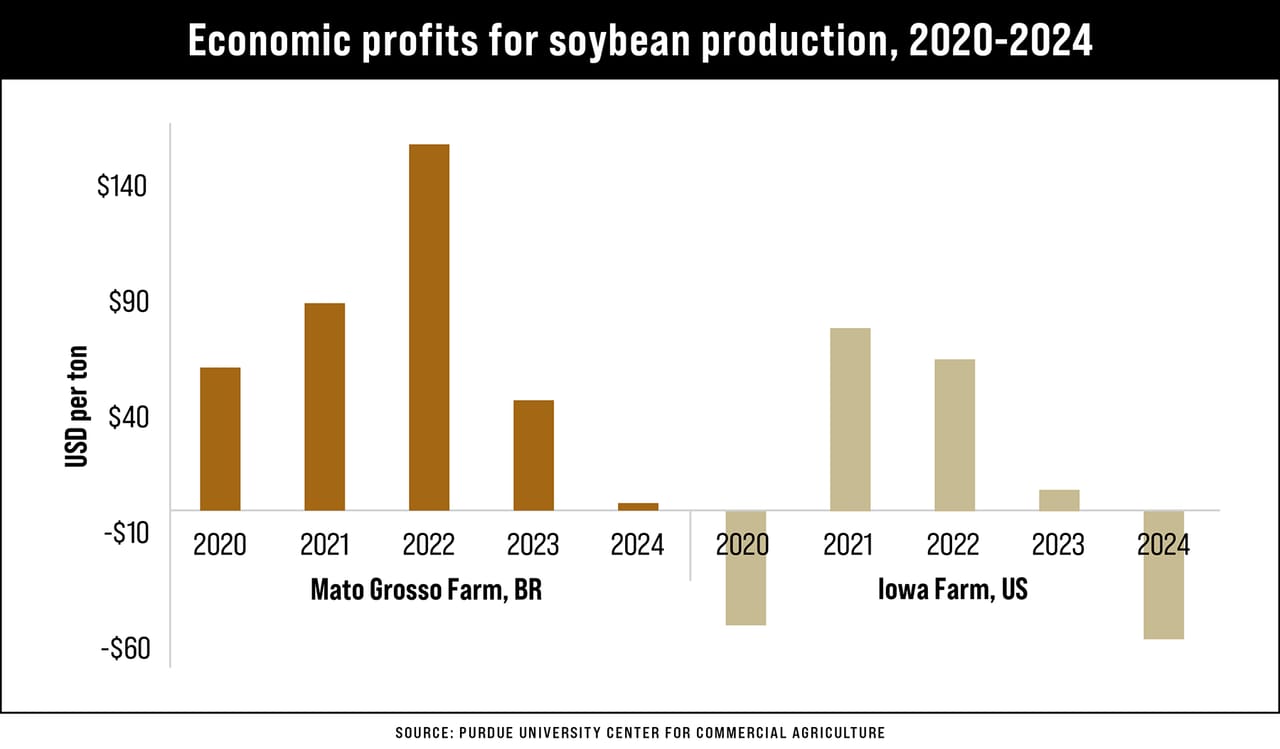
Revenue side. Higher soybean prices helped Brazilian farmers stay ahead of rising costs, although profit per acre, considering all costs, was barely positive in 2024. For the Iowa farm, profit evaporated after 2023 and was negative by $50 to $60 per acre in 2024.
Staying competitive in U.S.
Looking beyond 2026, Colussi said the key to staying competitive for U.S. soybean growers boils down to three key points:
- Improving productivity. More bushels per acre means total costs of production are spread over more beans to figure cost of production per bushel.
- Managing costs. Taking advantage of nutrients like phosphorus and potassium banked up in high-testing soils may help. Weed scientists indicate opportunities exist to still get effective weed control while watching budgets.
- Risk management. Utilizing crop insurance and monitoring key financial benchmarks are two ways to provide risk protection.